Table of Contents
Introduction
Magnets are used in countless applications—from motors and sensors to DIY projects and scientific experiments. But often, identifying the North and South poles of a magnet becomes necessary, especially when installing magnets in assemblies that require precise polarity orientation. This is where a Magnet Pole Detector Circuit comes in handy.
Using simple electronic components and a Hall-effect sensor, this circuit allows you to determine the polarity of any magnet instantly. It’s especially useful for students, electronics hobbyists, educators, and even professionals working with permanent magnet devices. In this article, we’ll explore how to build and use a magnet polarity detector using the APX9141 Hall-effect sensor IC.
Components Required:
| S.No. | Component | Specification/Description | Quantity |
|---|---|---|---|
| 1 | APX9141 | Hall-effect sensor (4-pin, dual polarity) | 1 |
| 2 | Red LED | Indicates North Pole | 1 |
| 3 | Blue LED | Indicates South Pole | 1 |
| 4 | Resistors | 220Ω – 330Ω (for LED current limiting) | 2 |
| 5 | SPST Switch | Single Pole Single Throw toggle switch | 1 |
| 6 | Battery Cell | 3V (e.g., CR2032 or 2 x 1.5V AA in series) | 1 |
| 7 | Battery Holder | Compatible with your chosen 3V battery | 1 |
| 8 | Breadboard/PCB | For assembling the circuit (optional) | 1 |
| 9 | Jumper Wires | For connections if using a breadboard | As needed |
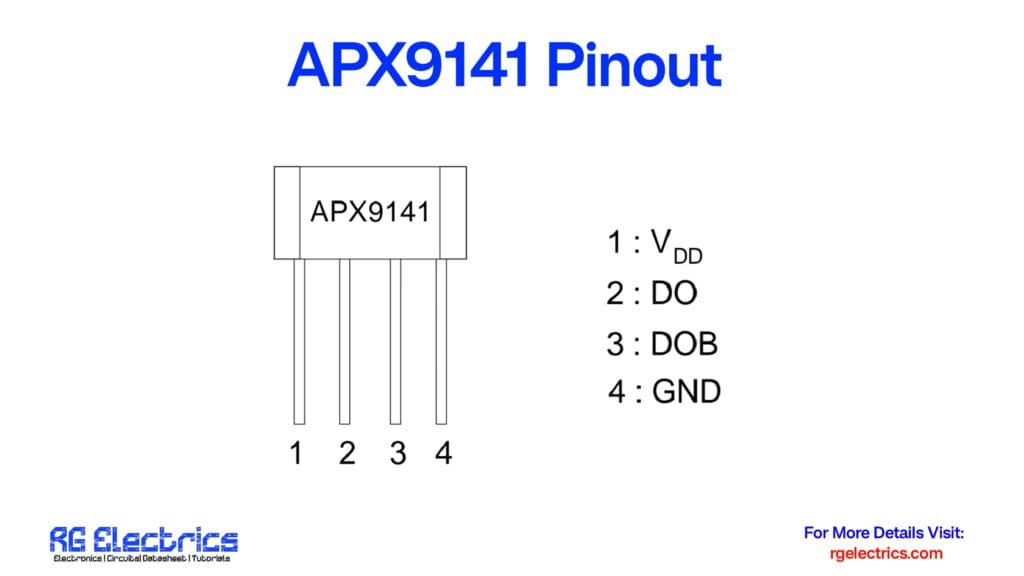
APX9141 Pinout
Circuit Diagram
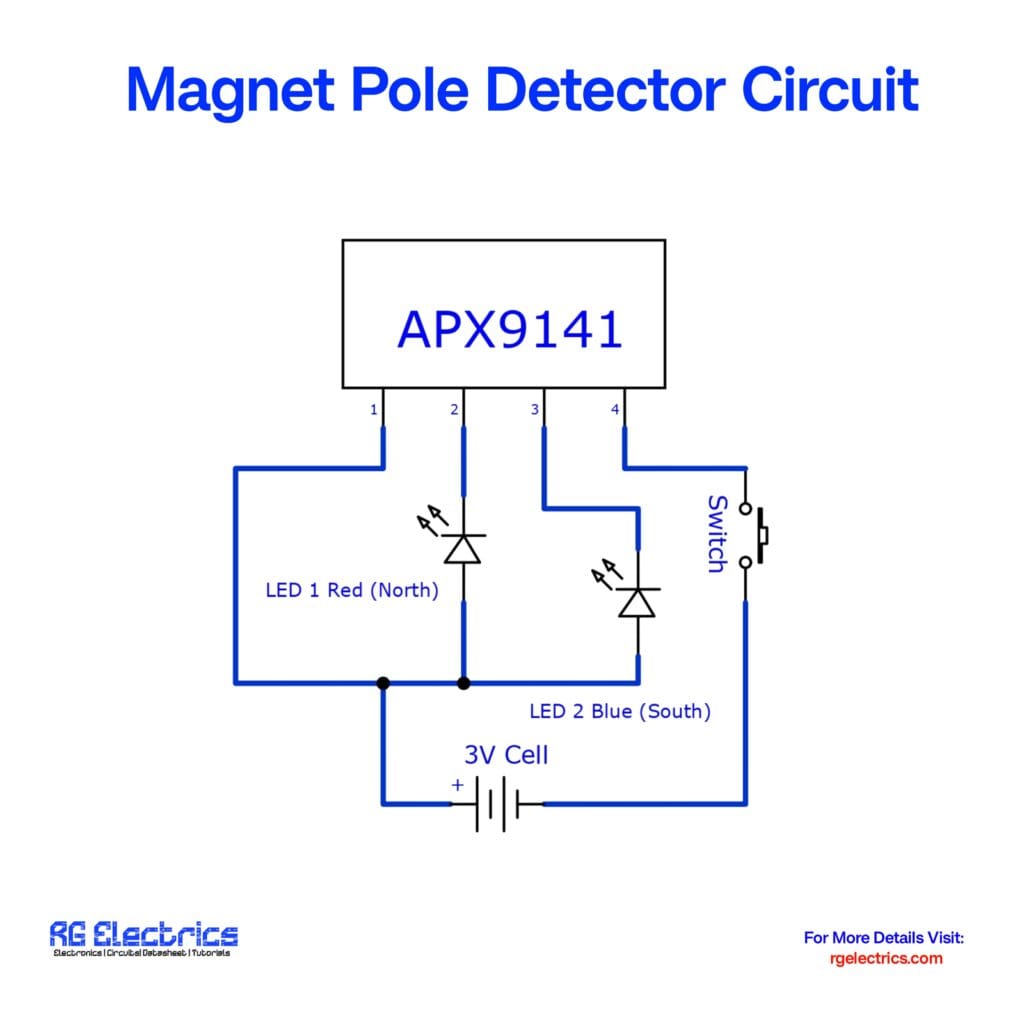
Circuit Diagram Overview:
The circuit is based on the APX9141 Hall-effect sensor, which has the unique capability to detect magnetic poles and produce two separate outputs—one for each pole. Here’s how the pins are configured:
- Pin 1: Vcc (3V power input)
- Pin 2: Output for North Pole detection (connected to Red LED)
- Pin 3: Output for South Pole detection (connected to Blue LED)
- Pin 4: Ground (GND)
When power is applied to the sensor via a 3V cell, and a magnetic field is brought near:
- If the North pole of the magnet faces the sensor, the output on Pin 2 goes LOW, allowing current to flow and illuminating the Red LED.
- If the South pole is presented, the output on Pin 3 goes LOW, lighting up the Blue LED.
The switch in the circuit allows you to conveniently turn the detector ON or OFF, conserving battery life.
⚙️ How It Works:
The APX9141 is a digital dual-output Hall-effect sensor that reacts to magnetic field polarity:
- Bipolar Operation: It can detect both magnetic poles separately and provides two digital outputs.
- Active-Low Logic: Each output pin pulls LOW when its respective pole is detected.
- LED Indication: The circuit connects LEDs in such a way that only one lights up depending on the polarity of the magnetic field applied.
This configuration allows you to instantly distinguish between North and South poles with the blink of an LED.
🧪 Applications:
This type of circuit has several practical and educational applications, such as:
- Physics Demonstrations: Visualizing magnetic fields and polarity.
- Motor Assembly: Ensuring correct magnet alignment in brushless DC motors.
- Sensor Calibration: Testing orientation of magnets in reed switch or Hall-effect sensors.
- DIY Projects: Ideal for robotics and automation setups where polarity sensing is crucial.
- Industrial Use: Verifying magnetic pole orientation during magnet production or sorting.
✅ Advantages:
- Simple Design: Uses basic, easy-to-find components.
- Low Power: Can be powered by a small coin cell or 3V battery.
- Instant Feedback: LEDs give immediate visual confirmation.
- Cost-Effective: A reliable and affordable solution for magnetic polarity detection.
- Compact & Portable: Fits in a small handheld enclosure for field use.
🧯 Safety Tips & Best Practices:
- Always double-check your connections before powering the circuit.
- Ensure your LEDs are connected in the right polarity (longer leg is usually positive).
- Use current-limiting resistors if your LEDs don’t have them built-in to avoid burning them out.
- Store the circuit in a non-magnetic case when not in use to avoid accidental triggering.
🧠 Conclusion:
The Magnet Pole Detector Circuit using the APX9141 Hall-effect sensor is a simple yet powerful tool for anyone working with magnets. Whether you’re a student, maker, or technician, this circuit provides a quick and visual way to identify magnetic polarity with high accuracy. With just a few components and basic wiring, you can build this handy tool in no time.