Table of Contents
Introduction
The 3.7V LED Dimmer Circuit is a simple yet highly effective electronic project designed to control the brightness of an LED using a low-voltage power source, typically a 3.7V lithium-ion battery. This circuit is widely used in battery-operated LED lamps, flashlights, and other portable lighting applications where energy efficiency and adjustable brightness are essential. It demonstrates the fundamental working principle of transistor-based current control in an easy-to-understand manner, making it an excellent choice for beginners and students learning basic electronics.
The circuit uses only a few components, including a transistor, resistors, and a potentiometer, making it cost-effective and easy to assemble. The main highlight of this circuit is its ability to smoothly vary the LED’s intensity without flickering, ensuring stable illumination at different brightness levels. It operates efficiently even at low voltage, making it ideal for rechargeable battery systems. Overall, the 3.7V LED Dimmer Circuit is a practical and educational project that showcases the importance of electronic control in lighting applications.

Components Need
| Component | Value/Type | Quantity | Description |
|---|---|---|---|
| Transistor | BC547 / BC548 | 1 | NPN transistor used for current control |
| LED | Any color (3.7V) | 1 | Light-emitting diode for output illumination |
| Resistor | 10kΩ | 1 | Limits base current to the transistor |
| Potentiometer | 100kΩ | 1 | Variable resistor used to adjust LED brightness |
| Power Supply | 3.7V DC | 1 | Battery or DC source for circuit operation |
| Connecting Wires | – | As required | For circuit connections |
| Breadboard / PCB | – | 1 | Used for circuit assembly |
Bc547 Pinout

| Pin Number | Pin Name | Description | Symbol |
|---|---|---|---|
| 1 | Collector (C) | Current flows out through this terminal; connected to load or positive voltage. | C |
| 2 | Base (B) | Controls transistor operation; receives input signal or bias voltage. | B |
| 3 | Emitter (E) | Current leaves the transistor through this terminal; connected to ground or negative. | E |
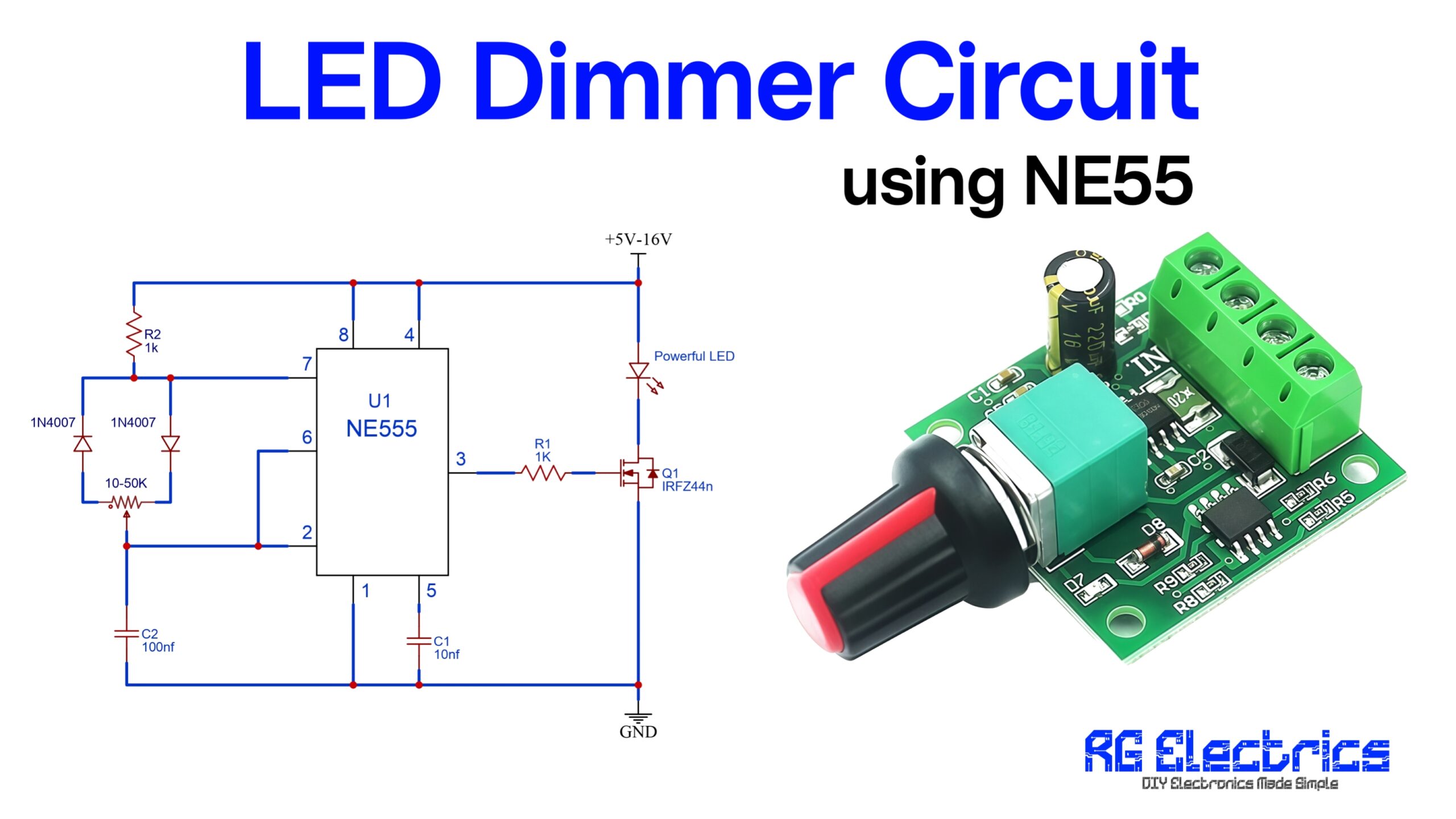
Circuit Diagram

Circuit Explaination
The 3.7V LED Dimmer Circuit is a simple electronic circuit designed to control the brightness of an LED using a single transistor and a variable resistor. It operates on a low voltage supply of 3.7V, which makes it suitable for lithium-ion battery-powered devices. The main components used in this circuit are an NPN transistor (BC547 or BC548), a 100kΩ potentiometer, a 10kΩ resistor, and an LED.
In this circuit, the potentiometer acts as a variable voltage divider that adjusts the base current of the transistor. When the potentiometer is rotated, it changes the voltage applied to the transistor’s base through the 10kΩ resistor. This variation in base current controls the transistor’s conduction level, allowing more or less current to flow through the LED. As a result, the LED brightness increases or decreases smoothly.
This circuit is ideal for small DIY projects, torchlights, and battery-powered LED systems due to its simplicity and low power consumption.
Applications
- Used in battery-powered LED lamps for adjustable brightness.
- Ideal for portable flashlight or torchlight circuits.
- Can be used in DIY electronic projects to learn dimming control.
- Useful for decorative lighting systems with brightness adjustment.